Fascinating hidden Microcosmos in Forest Soil

We, Nicole Ottawa and Oliver Meckes (eye of science) had the chance to take soil probes from places in the Black Forest Natural Park that have been untouched by humans for more than one hundred years. Samples were prepared for scanning electron microscopy and observed from several millimeters down to microns in size.
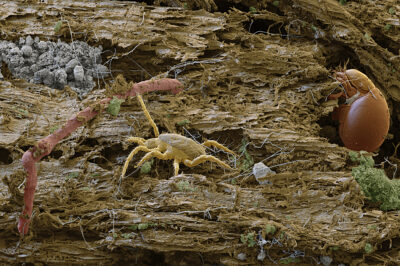
On the left you see a bristle worm, which is important for the mix up of the humus. Right next to it sits a predatory mite from the group Gamasina, which feeds on nematodes and other mites. The beetle mite (Oribatida, Phthiracarus sp.) on the right side is heavily armored and can completely close itself into a sphere.
On this piece of woody debris from soil of theBlack Forest National Park can be seen some typical inhabitants. Visible on the left is a bristle worm, which is important for the mix up of the humus. Right next to it sits a predatory mite from the group Gamasina, which feeds on nematodes and other mites. The beetle mite (Oribatida, Phthiracarus sp.) on the right side is heavily armored and can completely close itself into a sphere. Scanning Electron Microscope, 55:1 (at 15cm image width)

Natural soil is full of life. There can be more soil organisms numerically living in a handful of soil than there are people on earth. These are small insects, mites, worms, nematodes, ciliates (paramecium), amoeba, many other protozoa as well as fungi, yeasts and bacteria. The number of organisms is inversely proportional to their size. This means that there are thousands of protozoa and many millions of bacteria for every mite. All these organisms are involved in some way in the processing of plant residues. Fallen trees are just as important as fallen leaves in autumn or coniferous needles that are constantly “trickling”. Fungi are primarily responsible for the first step of decomposition of wood, because only they are able to metabolize the lignin of the wood. The fungi themselves are sometimes eaten by mites, and bacteria and protozoa start “their work” in the opened wood. Nematodes and predatory mites, in turn, eat bacteria or nematodes and, with their faeces, ensure that plants can ultimately resupply themselves with nutrients and minerals from the soil. All these processes are essential to keep a forest alive: after a tree falls it is decomposed throughout years and decades and the residues “feed” the trees again.

Testate Amoeba from wet soil.
A Testate Amoeba (Trinema complanatum) from from the soil of the Northern Black Forest (Wilder See). Here, the opening, which is important for the determination of the species is clearly seen. Testate amoebae (formerly thecamoebians, testacea or thecamoeba) are a polyphyletic group of unicellular amoeboid protists, which differ from naked amoebae in the presence of a test that partially encloses the cell, with an aperture from which the pseudopodia emerge, that provides the amoeba with shelter from predators and environmental conditions. Scanning Electron Microscope, 5000:1 (at 15cm image width)
Heliozoa commonly known as sun-animalcules, are microbial eukaryotes.
Heliozoa are microbial eukaryotes (protists) with stiff arms (axopodia) radiating from their spherical bodies, which are responsible for their common name. The axopods are used to the catch of prey and the increase in water resistance to slow down sinking. Scanning Electron Microscope, magnification 3500: 1 (at 15cm image width)

About the author

Nicole Ottawa and me founded "eye of science" in 1995.
Nicole is biologist, I'm an educated photographer. we both had an education for scientific photography at the "Institut für Wissenschaftliche Fotografie" in Weissenstein.

More from author