Forty Five Years On…

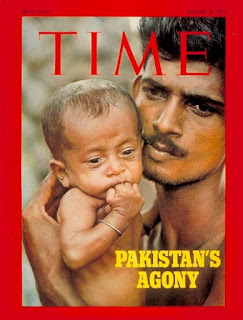
I sometimes wonder if our parents thought about time, and the passage of time, in the way we do. Though I can’t recall any conversations with my folks about it, I suspect they were more concerned with just trying to deal with the next day, week, or month, and didn’t have the time or inclination to ponder their aging world and how they fit into it. My whole adult life has been spent taking photographs, for the most part for magazines, as a story teller of the most-decidedly analogue variety. For most of the five decades I’ve been working, film and the necessities it demanded were part of the picture (literally!). But tonight after dinner, I had one of those moments when all of a sudden, the date gave me pause. It’s July 23, 2016, and being a former math major I started doing the obligatory backtracking, and realized that this week is the 45th anniversary of my first TIME Magazine cover story. Forty five years. It’s not Diamond, nor Silver, and probably not even Tin. But it might be The Plastic Stuff Film Cans Were Made From. Yeah, forty five.
A man carries his mother through the rain to a refugee tent cover, W. Bengal
That summer of 1971 I had been living in Saigon for the better part of a year, had more or less become one of the TIME photographers working that bureau, and that is when news started flowing out of West Bengal about the refugees fleeing persecution in East Pakistan. (Six months later, following a war between India and Pakistan, East Pakistan would re-emerge as Bangladesh.) David Kennerly, then working for UPI out of Saigon had just come back from spending a week in India working on the refugee story, and told me it was one of those stories which really needed to be covered. People needed to know this was happening. I had sent a note to Timepix New York for approval to head to Calcutta to cover the story, and the next day a telex came confirming that I was on assignment.
a young boy clings to someone close, Refugee camp, W. Bengal
I arrived at DumDum airport late the next night, my first time in India, and soaked up the amazing, unforgettable sights, sounds and above all, smells. The woody smoke from cook-fires mixed with the myriad sounds creating that first impression that still remains. I took a room at Grand Hotel, and though it wasn’t as Grand as Garbo’s, it was a great place to operate from and featured a bar whose denizens of the Fourth Estate gave unending combinations of fact and fiction over Pimms and Gins. I hooked up with a Bengali photographer from the Statesman (Symadas Basu) and we roamed the border areas for the better part of a week, searching for photographs. You didn’t have to look very far or very hard to find something. There was a virtually unending stream of people, on foot or oxcart, slowly but inexorably heading West. I remember looking at the faces of those people as our paths crossed, thinking that what they were fleeing must truly be awful. Millions would not simply give up all, and move, unless there was something very terrible on the other end.
crowds of refugees seek space to lay down, to sleep, in a W. Bengal camp
Each night when I’d return to the Grand, I would make a packet of film (Ektachrome 64) for New York and through the miracles of modernity, 30 hours later my cassettes would be on John Durniak’s desk. Captions were always rather broad and hazy, but the pictures for the most part would speak for themselves. It was still very much the age of Telex (look it up!) and when I received word that the next week’s magazine would feature my picture on the Cover, along with a four page spread inside, I felt I had done right by the story. It was truly a different time, and while today’s weekly magazines are a slim notion of their former selves, at the time there was satisfaction in knowing that in the week following, some 20 million people would see your story. (This was still a decade before the founding of CNN!)
D.B.  age 24, Khe Sanh, VN  1971  (*photo © Chris Callis)

When you have worked for nearly fifty years as a photojournalist, almost every week offers some modest or major anniversary of some kind. Most are forgettable to all except the few that lived them. I noticed in the last few years that too, too many of my discussions with friends would start with something like “…that reminds me of a story I did 35 years ago,….” and I think that perhaps I’m the only one finding those moments so prescient and full of vibrant memory. We Baby Boomers were given much, perhaps too much, but perhaps the one thing we might be worthy of are our memories of the 20th century. I have worked long enough to see many of my stories morph from journalism into history. That alone has reminded me that a life with camera in hand was perhaps a worthy one. But I’m sure I’ll keep doing the math here and there, finding some little anniversary which will let us focus again, if briefly, on a moment of our times.  We’re just sayin’…. David

“The Invisible Strobe” At PhotoPlus Expo

NYPHOTOEXPO_2016-Ad.660

Capturing quality images at high ISO’s has not only opened up new avenues for shooting in natural-light, it also has turned handheld strobes into powerful lighting tools. For more than twenty years, Gerd Ludwig has been a master of using small TTL-flashes in unusual and unpredictable ways – to emphasize his message, offer a sense […]

Proboscis monkey becomes National Geographic Photo Ark’s 6000th species.

A proboscis monkey (Nasalis larvatus) at the Singapore Zoo.

A proboscis monkey at the Singapore Zoo has become the 6000th species to come on board the National Geographic Photo Ark! Males of this species may use that huge nose to attract females and to amplify alarm calls as well.  A breeding colony of these endangered primates is kept at the Singapore Zoo, one of the […]

The post Proboscis monkey becomes National Geographic Photo Ark’s 6000th species. appeared first on Joel Sartore.

WHAT’S A PLIERS?

I recently got a telephone call from my son, Anthony. “Hey, backyard engineer,” he said, “How’s everything?” That salutation was due because of my recent efforts—eventually successful—at turning your ordinary Coleman cooler into a fish live well for the 14 … Continue reading →

D-Day+ 72

The trip began as a diversion from the post-election blues in Paris, 1974.  The French had just elected a new President. I’d been lucky enough to be his personal photographer (if you have a choice between driving to the event in Clermont-Ferrand, or hopping the candidate’s private jet, take my advice, go with the jet!)  Two good friends, Tom Herman and Robert Wiener, both of whom were living in Paris, reminded me that as it was the beginning of June, we should head on up to Normandy for what was billed as a big “thank you” to the Allied troops who had, 30 years before, taken part in the D-Day assault which eventually drove the Germans out of France, and ended World War Two.   So off we went in a rented car.   At the time, I hadn’t really put together that anyone I knew at home in Salt Lake, had much to do with the War. Mr. Tolman, whose magic at teaching History only became obvious to me decades later, had been a bomber pilot, and was perhaps the only one I’d met growing up who shared his experiences.  And his take, more impish and full of humor than heroism, included his description of the mandatory  “… and there I was…”  moments which I’m sure he’d heard too many of from his veteran friends.  (His “and there I was” moment usually involved a description of his plane dropping its bombs on a cow pasture….)  Later I would understand that those who lived though the tough stuff were generally much less inclined to share their stories than the REMFs who seemed to tell stories at the drop of a hat. 

On arrival  in Normandy, we made our way to most of the official events.  There was a mock-assault by current-duty US troops up Pointe du Hoc, watched by some of the Rangers who’d been there in ’44.  A tribute to General Omar Bradley, accompanied by his iron-willed wife, he being the last senior US commander to attend a reunion.  And the event which moved me the most, and opened my eyes to the reality of who these solders really were:  A lunch offered by the town of Vierville (Omaha Beach) for hundreds of vets and their wives that became a focal point for all my attention.  It was another chance for the citoyens of Normandy to say thanks.   

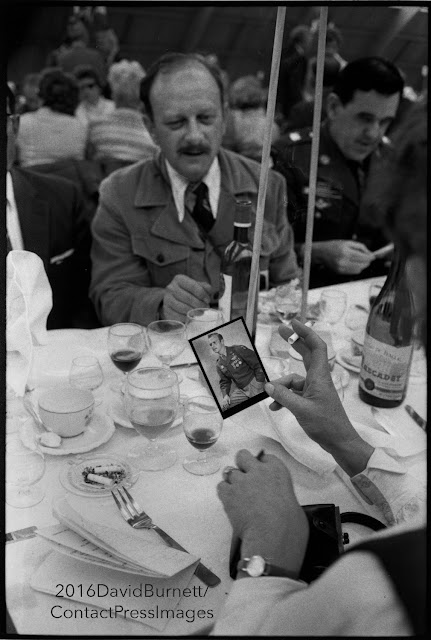
At the lunch, wine was served probably accompanied by a few things that most of the vets might have seen as inedible.  The French can be like that.   But beyond the dishes, there was a warmth and welcoming feeling, one which totally belied the old saw about the French being aloof, and not friendly towards the Yanks.  There was a moment when it all came into a frame for me (the Leica M4/35).   One of the vets was sitting opposite a very elegant French woman.  Well, at the least, she had very elegant hands.  Given this was the 30th anniversary, the vet was probably in his early 50s.  He looked as if he were still  of a working age, wearing an early version of a leisure suit.  There was nothing about him that seemed terribly special, but as we all know, special pictures can happen anywhere. 

He had handed over a snapshot of himself from the war, one of those portraits that everyone had done, and you can absolutely see his whole life.  From the rakish young man, mustache carefully trimmed, hair slicked back,  uniform fitting to a T, to the look of insouciance, as if he didn’t really have anything more important to do. He seemed very much at home with himself.  Comfy in his uniform, if not his skin.  Near me, on my side of the table, with a bottle of Muscadet on the ready, the French woman holds the picture, using her thumb and 3rd finger, her forefinger busy holding the most elegant cigarette ever.  You see the space of the the thirty years.  And in that moment something struck me.  The combination of American spirit, and Gallic formality.  The saved thanking the saviours in the manner they best know. 

I began coming back to Normandy again in 1979, then in 1984, and every ten years since.  It has become a story I can’t stay away from.  When you meet the vets – literally our uncles, our dads, our folks’ school buddies, you feel the appreciation for what they did, and how they did it.  They spent several years in uniform understanding they wouldn’t come home till the war was over.  They did their part.  Some saw months of combat, some drove trucks, some flew planes.  But they all understood that the ultimately the  job was about finishing what they had to do.  Over the years have I have done this story, I’ve felt a sense of envy for the camaraderie that they shared with each other.  How do you acknowledge those who did something for a cause greater than themselves.   I guess you say Thanks.   
June 6, 1974   Vierville sur Mer