Fall of Babylon


We emerge from the ranks of rocky hills dressed in bright spring wildflowers the way a night sky may be studded with stars well after midnight. Sea fog rises and falls, and the Atlantic coast of western South Africa is still invisible, but we can see mounds of tailings stretching for miles. A mine. We poke around a seemingly empty building — a guard station? — until two uniformed security guys show up. Yes, a mine. Diamonds. And another company town, hushed against the ground, barely lit, subdued. Miraculously, the guys let us stay in the mine’s parking lot and spend the night.


“Do you live in Alabama?” one of them wants to know.  I tell him no, and he sights: “Alabama…” “Have you been there?” I ask. “No,” he says, “but I watched a TV show. From Alabama. I liked it.” 


We park, and before we cook our nightly soup we have visitors. Two tiny owls perch in the tree above our camper and then screech their way to the nearest roof and sit there, little hunchbacks with pointed Leonard Nimoy’s Vulcan ears. The fog eats the land, traps the day’s warmth, and holds it till the daylight returns many hours later. We roll on to the coast.  


Hondeklipbaai. What is this collection of dwellings held together by tin and old paint, and a few better cabins with blue trims? The place seems to speak of little money and much struggle to hold on. Is it a fishing village? Surely not, what with its piss-poor harbor, barely protected by a few coastal rocks and smacked hard by every wave which happens to show up. A vacation spot? Again, not with these shanty-flavored outhouses, two deserted campgrounds and bumpy gravel roads ending mostly nowhere, even though the community —
with tiny patches of gardens and no trash anywhere — is not unloved. 


But we are wrong. A man we ask says it is both, and more: it is also a mecca for men diving for diamonds. Does he fish? Yes, for lobster, but the government makes it harder than ever by cutting fishing quotas to the bone and allowing big boat boys to have their heyday. Does he dive for diamonds? Yes. How deep? Down to 18 meters. Dry suit? No. But the sea is cold, we say, and suddenly understand the wet suit he obviously uses is not his choice: it is what he can afford.  


We need drinking water, so I pass the harbor with its diamond diving boat and several bobbing skiffs, and head for a funky coffee nook, one of the few establishments in town. The owner is blond and very helpful. She does not have much water to spare but will let me have some, except I may not like it. Is it bad? I ask. Well, it is brack, she says, and some folks get sick from it. She has a small filter she uses but I have been already battling my African intestinal unrest three times and will skip her brackish water unless we run totally dry. 


Her tiny open kitchen is crammed with paintings. Yes, she paints, and the whole dusty outdoor gallery is hers and her husband’s. We 
talk. I feel my brain slipping into my old “just listen” journalistic mode as easily as my feet slide into my old hiking boots. Her name is Madelaine but she did not like being called “Mad” and added a “z’ to the end: Madz. Madz the artist, from Hondeklipbaai, South Africa.
I take her picture . “Should I hold a brush?” she asks, and I say yes. Then John and I eat her breakfast food, a toastie with slices of ham, tomato and cheese. We hug. She gives me her business card. It is all so simple and unforced I want to sing.


Outside I bump into her man, Deon. Red face, small pony tail, quick, followed by a posse of dogs. I tell him I like the paintings in the yard, and he informs me they sell from as little as 500 rand to as much as 2,500 for the big ones. Some go to America, and one just went to Iceland. Wow, I say, and he invites me to his studio, a tiny white trailer half buried in blossoming flowers and half occupied by a bed which has not been made for a while. He tells me he never invites anyone in, not even his wife, because he likes to be antisocial there and just paint. But now he just talks. 


I listen, and feel as if the last three months of watching great African animals abruptly ended and I was now among my own herd, attuned to its needs to be heard and understood.  Deon tells me about his early painting days when he just played with pictures and moved all around the country. And then about his five years in prison and two out on parole. Armed robbery. Some fellow owned him a chunk of money but would not pay back, so Deon went and took what he could. Had a gun. Got caught. 


My eyes slide away from his easel with a bright seascape under construction and move onto a wall. A nude, standing by a chair. Red hair. Dark nipples.  Great composition. “Oh, she was my social worker in prison,” Deon says. “No, she did not pose naked. One day, she came into my cell — it was really tiny — and I suddenly saw her like this.  And here she is, just as I saw her.” He says that after the prison he just wanted to hide and have a quiet life by the sea. Came here. Got to paint a lot, to sell. Met Madz on Facebook. In a few years, he wants to be one of the best 10 painters in the world.


He watches my eyes really closely now, and follows them to a painting sticking out of a pile of seascapes sitting by the door. I can make out some vague outlines of monumental structures collapsing as if under their own great weight and a pair of bare breasts. But there is more.  Deon dusts the canvass off and slaps it extra hard to get rid of some grit I cannot detect. “This one,” he points to a woman in a on top of the picture, “is my ex-mistress. And this one is my ex-wife.  They both just cut my head off — see?”  I see: it is his head, long haired, bloody, inert. And then he adds: “I call it Fall of Babylon.”  


We leave the studio. Shake hands. The sky begins to brighten. I will send him the pictures I took. And he can be antisocial again and just paint. Maybe more landscapes, maybe his life. Whatever comes next.  ©Yva Momatiuk

www.momatiukeastcott.com

not here

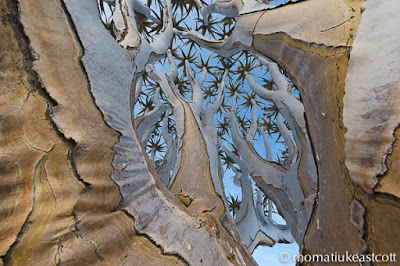
Quiver trees — also known as kokerboom — thrive in the southern Namibian desert.

They eat rocks and drink sand, take many years to grow, and as they expand their girth their bark splits and reveals a smooth underlayer in different shades of rock and sand. I like to think that if they were snakes they would shed their tight old bark. But no: they just allow it to crack open and stay, maybe forever. The bark is hard and smooth but the innards are surprisingly spongy and serve as reservoirs of many gallons of water sucked in by the trees during rainy seasons. This pliable softness made it easy for the Bushmen of the Kalahari to hollow out the trees’ branches and use these tubular containers as quivers for their deadly arrows.
And here is what happens when John and I look up at quiver trees: we get dazzled. This is because no other trees we know flaunt such exquisite split bark lines along their bodies, the lines which twist, bend and disappear around the next turn. And when we photograph them in a sweet open shade of dusk they also shimmer and cover our lenses with a film of a waxy dust so thin you would never believe how hard it is to get it off.  We know all this, because some weeks ago we spent a whole evening out in the desert with three of them, until the evening became night. And then we had quiver dreams, too, as if unwilling to part with their beauty.
That was some time ago, but it sent us looking for more. And now we are on a quiver tree farm, reputed to preserve the densest quiver grove in all of Namibia, and coupled with some desert acreage covered by large boulders and called, as such places usually are, a playground. Of giants, I think, or some such. 
There are signs here sternly detailing “forbidden” behavior, and clean toilets and a spacious campground, and even a restaurant and a pet warthog and a couple of cheetahs. The cheetahs get fed at 4pm, sharp. Yes, this is a commercial enterprise, and we are not to forget there are certain charges. We understand the owners of this land want to present it to visiting tourists but also prevent any potential problems which often follow the opening of one’s hospitable doors. And since we fell in love with quiver trees, we hope we can put up with what any commercial venture can be expected to inject into our tree experience.
We take a look at the giant boulders which are brown and unremarkable, and quickly move on to the trees. There are some walking trails here, and a good number of quiver trees of all sizes, bolstered by more brown boulders. We walk and walk. We look and look. And try, and try again. Then, as the evening darkens, we meet somewhere on the slope and silently shake our heads. No, it did not happen. No pictures. No enchantment. No music lifting our spirits. A flat void. 
Later we try to dissect the reasons. We quote the signs suggesting prosecution by the owner of the grove: perhaps our minds became too tight and worried because of these naked threats?  We also come up with the wrong age of the trees: are they too old and already outlived their most beautiful stages? I even remember a noisy tourist who seemed to be everywhere at once, talking incessantly to her two silent male companions: maybe her loud voice prevented me from concentrating and really seeing what I came to see?  We string all these and other reasons into an impossibly convoluted web of excuses. But it all sounds lame and untrue.
“Listen,” I say to John, “I think I may have a picture I like. At one point, I put my head inside the canopy of a really old tree, and met a rock hyrax who came up from the other side. We almost bumped our noses, and it was totally unexpected for both of us.”  We find the frame and look at it together. The hyrax, bright eyed and alert, is — after all — considered the closest living relative of an elephant, and even if we are not sure if this information is reliable it is nice to think you can meet it up the tree when all else is lost. 
We look again at my little picture and suddenly understand what we are missing here. We miss the enchantment which comes with solitude and not knowing what will happen next. We miss the sense that we must trust some forces outside ourselves which can make things happen unexpectedly at any time. Yes, there is the grove and the trees and the trails to walk around them. But it is all too set, too ready to be appreciated and photographed to be magnificent and dazzling. It is predictable and finite, and we cannot make it intimate and our own. And except for the little hyrax there are no surprises, the very essence of what we need. He saves the show a bit, but just enough to see that such well appointed offerings are alien to us and as many times removed from our joy as he is from his distant elephant cousins.
©Yva Momatiuk

www.momatiukeastcott.com

talking to animals

“Yes, you, the little springbok. Get you head up.”
“No, not you.. the one behind you.”
“Please do not cover his horn with yours. Please.”
“Now, move to the right and stop scratching. I cannot see your head when you do this.”
“How about a drink? And may I see your lapping tongue?”
John and I are huddling at a remote waterhole in Etosha National Park in Namibia, and I am trying to communicate my artistic needs to several dozen animals who drifted in from the surrounding flatness of the desert to get a drink. And the more actors appear on my stage, the harder it is to find a composition which moves the heart. I see my monologue falls on deaf ears but hey, it does not hurt to try.
“Please don’t move! Not one step.”
“Turn… turn… turn… a bit more. More. Thank you. This is really good.”
“Stay there if you can. Please. I am still waiting for that oryx.”
“Where are you going? They may finally all drink, and you will get in front of them.”
“Keep moving! Now you are overlapping with my ostriches.”
Only this morning I realize that as soon as I bring my eye to the viewfinder of my camera to photograph wild animals, I begin to talk to them, usually in my mind. But here in Africa I actually speak. Softly, in a low and constant patter. I am polite but also maddeningly persistent. And I offer a string of suggestions, even though the animals are oblivious to my desires.
“If you just move left, this foal could also get in and get a drink, too. And I need him there.”
“What are you doing? Please stay out of my frame, just for a moment.”
“You are about to cover my oryx, and you don’t want to get into this mud anyway.”
“See? This was no good. Just stay where you are: your ass looks perfectly good there.”
“Oh no! This was such a wrong move… My mistake. Sorry.”
Persistently, and at times desperately, I am trying to choreograph the animals coming into my frame. They do what they want, but I do not quit. But why am I not content with what I see, and instead try to direct them, even if what I do is so ridiculous? Perhaps some ancient cultural imperative of all humans is making me try to rule this wild and unruly roost. Or maybe I want these photographs to show the awe I feel when I am in their presence, and I need my animals to help me. But this is not it.
I just love them. The little springbok, who ruins my composition. The ostrich, who shows me his plucked ass when I need his head and overlaps with another giant bird. The oryx, who seems to walk on someone’s back. 
And I feel this love makes them my good and tolerant friends. They may not do what I want but at times they will suddenly do far more than I had ever asked them for, and overwhelm me with their wild and boundless generosity. They will suddenly show me what I could not even imagine possible. And it will be perfect in every way.

Not today, but maybe soon.     ©Yva Momatiuk

www.momatiukeastcott.com

“Nuclear Tourism” Exhibition at Visa Pour l’Image

CHERNO_130927_29461.4.660w

“Nuclear Tourism,” a selection of Gerd Ludwig’s photographs of tourism in the Chernobyl Exclusion Zone, will be exhibited at Visa Pour l’Image in Perpignan, August 29 – September 18, 2015. In 2011, as people around the world watched TV reports on the nuclear meltdown in Fukushima, the Ukrainian government gave approval for travel inside the […]

The Long Shadow of Chernobyl App Updated

CHERNO_110319_17517.1.660w

“The Long Shadow of Chernobyl” iPad app was just re-released for iOS 7 and later, with a new design and updated material. For those who already had the earlier version, a free update is available via the App Store. Spanning Gerd Ludwig’s two decades of documentation of the aftermath of the Chernobyl nuclear catastrophe, the […]

Global Activism: La Isla Foundation

Photo©2015 Ed Kashi/VII

Jason Glaser of La Isla Foundation was recently interviewed on WBEZ’s Worldview about his work surrounding the epidemic of kidney disease among sugarcane workers in Nicaragua. “La Isla Foundation was formed in 2008 after independent filmmaker Jason Glaser met Juan Salgado, a community organizer from Candelaria, Nicaragua. Jason was in…

The post Global Activism: La Isla Foundation appeared first on Ed Kashi.